CWEB programs
In this section a set of the CWEB programs I have written over the years can be found. CWEB is a dialect of literate programming which I find very convenient for the writing of my more complex programs, as it allows me to write a neatly documented record of the algorithms in plain TeX meanwhile also implementing them using my favourite programming language, ANSI-C. Unless you are already familiar with the concept of literate programming, you may benefit from reading the introduction first.
Estimating the fractal (Hausdorff) dimension of curves in the plane
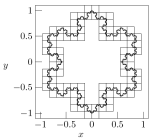
The BoxCount computer program calculates box-counting estimates of the fractal dimension of curves in the two-dimensional plane. In the box-counting estimate to the fractal dimension of a curve in the domain {x, y : xmin ≤ x ≤ xmax, ymin ≤ y ≤ ymax}, a grid of squares, each of horizontal dimension (xmax - xmin) / 2m and vertical dimension (ymax - ymin) / 2m, is superimposed onto the graph for integer numbers m. By counting the total number of such squares Nm needed to cover the entire graph at a given m (hence the term »box counting»), an estimate Dm to the fractal dimension D (or Hausdorff dimension) is obtained as Dm = ln(Nm)/ln(2m). This procedure may be repeated many times, with Dm → D as m→∞ for real fractal sets. However, for finite-depth fractals (as generated by a computer), some limit on m is necessary in order to prevent trivial convergence towards Dm → 1. In addition to mere numerical calculation, the BoxCount program also generates graphs of the box distributions, in form of MetaPost code which can be post-processed by other programs.
Simulating the electrodynamics of nonlinear magneto-optical Bragg gratings
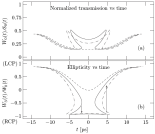
The MagBragg computer program calculates reflection and transmission spectra of nonlinear magneto-optical Bragg gratings, in a stratified geometry where the material parameters vary only in one Cartesian coordinate. The MagBragg program also simulates the propagation of the electromagnetic field of an optical wave as it traverses a magneto-optical Bragg grating, giving the intra-grating spatial distribution of the optical fields in linear as well as nonlinear optical regimes. The MagBragg program forms the core behind the semi-analytical algorithm that in 2006 was published in Phys. Rev. Lett. 96, 063902 (2006). The MagBragg program is written in CWEB.
Simulating the Wiener process in D dimensions.
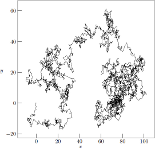
The WIENER program computes a series of floating-point numbers corresponding to a Wiener process in D dimensions. The program relies on the random number generator as proposed by Donald Knuth in The Art of Computer Programming, Volume 1 – Fundamental Algorithms, (Addison-Wesley, Boston, 1998), generating numbers which are fed into the Box–Muller transform to generate the normal distribution associated with the Wiener process. Besides providing a simulator of the Wiener process, the WIENER program can also be used in a "lock-in" mode with zero expectation value for each data point, providing a pretty good random number generator for large series of stochastic data, not relying on the (rather poor) generators available in standard C libraries. The WIENER program does not solve any problem per se, but is merely to be considered as a generator of statistical data to be used by other applications in modeling of physical, chemical or financial processes.
The Savitzky-Golay smoothing filter
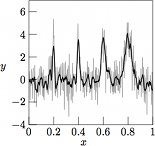
The SGFilter computer program provides a stand-alone implementation of the Savitzky-Golay smoothing filter. This filter was originally proposed in 1964 by Abraham Savitzky and Marcel Golay as an algorithm of recovering feature characteristics from noisy spectra, overcoming the drawbacks of simpler noise-reduction techniques such as running averages. The work-around presented by Savitzky and Golay for avoiding distortion of peaks or features in their spectral data is essentially based on the idea to perform a linear regression of some polynomial individually for each sample, followed by the evaluation of that polynomial exactly at the very position of the sample. While this may seem a plausible idea, the actual task of performing a separate regression for each point easily becomes a very time-consuming task. However (and this is the key point in the Savitzky-Golay algorithm), the coefficients involved in the actual regression may be computed once and for all in an early stage, followed by performing a convolution of the discretely sampled input data with the coefficient vector.
Creating Encapsulated PostScript (EPS) images of arrayed data
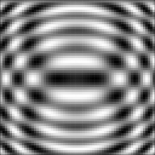
Given a matrix of floating-point numbers stored in a regular ASCII text file, the EpsImg program creates a grey-scale Encapsulated PostScript (EPS) image of the matrix using its elements as specification of the brightness of the corresponding pixels in the image. Of course, there are other ways of generating Encapsulated PostScript images of sampled of simulated data, as for example using the image() function of MATLAB. However, an advantage with using a stand-alone program is that it is easily incorporated in scripts for batch processing. In addition, the EpsImg program is provided free of charge. The EpsImg program is written in the CWEB programming language; however, as it is targeted towards generation of Encapsulated PostScript, the main entry for this program is under the PostScript programs section.
Generating TeX source code for the typesetting of labels for digital video tapes
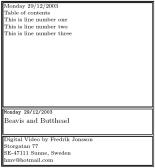
The DvLabel computer program generates plain TeX source code for typesetting of labels for digital video tapes (DV format, typically used for hand-held video camera recorders). The DvLabel program is primarily designed to run in interactive mode, but via command-line supplied parameters it also supports batch-mode operation. I got the idea of creating this program from the audio-tape.ps PostScript code by Jamie Zawinski. The audio-tape.ps code is a splendid example of how one can write a simple PostScript program with the help of a regular ASCII editor, and by sending the PostScript program to the printer one gets a neat printout to be used for tape cassette labels, DAT, or video tapes. However, whenever one has a new cassette to be labeled, one has to edit the PostScript source, and for a rookie on PostScript programming this task is for sure somewhat inconvenient. (Believe me.) The DvLabel program is written in CWEB.
